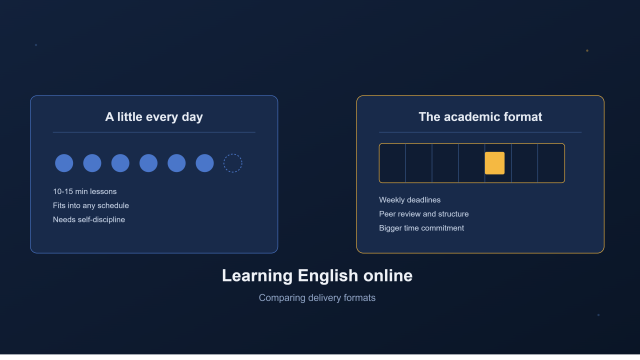
You want to sound more confident in meetings, pass an exam, or simply stop hesitating before every sentence, and a full university program is not something your schedule allows. Learning English online has become the obvious answer, yet the format you pick, short daily lessons or a structured multi week course, shapes how much progress you actually see. Before you subscribe to anything, it helps to understand what each delivery format asks of you and what it gives back.
How Online English Learning Actually Works
When people talk about learning English online, they usually mean one of two models. The first is a stream of short, self-paced lessons you complete on your own schedule, often through an app or a platform built around bite sized video content. The second is a cohort-based course, where you move through the material alongside other learners, follow a syllabus and hit weekly deadlines.
Neither model is inherently better. A self-paced lesson bank rewards consistency and lets you fit English practice around work or family life. A cohort-based course adds structure and social pressure, which some learners need to actually finish what they start.
Short Daily Lessons vs Structured Courses
Platforms built around short daily lessons, the kind you will recognize from Skillshare style catalogs, work well if your goal is conversational fluency. Ten or fifteen minutes a day, repeated over months, builds vocabulary and listening comprehension without demanding a fixed block of time. The tradeoff is accountability. Nobody checks whether you opened the app today, so results depend heavily on your own discipline.
Academic style courses, closer to what you find on Coursera, work differently. They typically include a syllabus, assigned readings, and peer-reviewed assignments where other learners assess your writing or speaking exercises. This format suits business English, exam preparation, or any goal tied to a specific outcome, since it forces regular output rather than passive listening.
Certificates, Subscriptions and What They Really Mean
Before choosing a format, it is worth understanding a few terms that show up on every platform’s pricing page. An audit option usually means free access to course material without a certificate at the end. A subscription model charges monthly or annually for unlimited access across a catalog, which suits learners planning to take several courses over time. Paying per course makes more sense if you only need one specific program.
An accredited certificate, often tied to a university partner, carries more weight on a resume than a platform issued badge, though neither guarantees a job or a promotion. Treat a certificate as evidence you completed structured work, not as a credential that replaces real conversational practice or an interview performance.
What to Look For Before You Commit
A few practical checks save time later. Confirm whether the course offers mobile access with offline downloads, since many learners study during commutes. Check whether lessons adapt to your level automatically. AI powered platforms increasingly offer personalized learning paths that adjust difficulty based on your answers, which can shorten the time spent on material you already know.
Also look at how speaking practice is handled. Some formats rely entirely on recorded exercises, others pair you with a tutor or a peer group. If your main goal is speaking confidently in real situations, a format without live interaction may leave a gap no amount of vocabulary drilling fills.
Finding the Format That Fits Your Schedule
There is no single best way to approach learning English online. If you need daily habit building and conversational ease, a short lesson format usually delivers more consistent progress. If you are working toward a certificate for business English or academic purposes, a structured cohort-based course, despite its heavier time demand, tends to produce more measurable results. Match the format to your goal and your available hours before you match it to a platform’s marketing page.
FAQ
Is a short daily lesson format enough to become fluent in English?
It can build vocabulary and listening skills steadily, but fluency in speaking usually needs some form of live conversation practice alongside it.
Do I need a certificate to prove my English level?
Not always. An accredited certificate helps on a resume, but many employers care more about demonstrated speaking ability in an interview.
What does audit mean on a course page?
It means you can access the lesson content for free, without receiving a certificate at the end.
Is a subscription cheaper than paying per course?
It depends on how many courses you plan to complete. A subscription suits learners taking several courses over time, while a single course is often better paid individually.
Can AI-powered courses replace a tutor?
They can personalize pacing and difficulty, but they rarely replace the feedback and correction a live tutor or conversation partner provides.